 Main Street Desk
The Label Says Two or Three Times a Day. Remembering Is the Hard Part.
Herb Pharm's Brain & Memory is one squeeze of a rubber bulb into two ounces of water, between meals. What that asks of a day, what the trials asked of theirs, and what customers said about keeping it up.

This is a paid advertisement. Sponsored by Herb Pharm, LLC.

The directions on this one-ounce bottle take four lines, and the last of them is the one that decides whether the bottle is worth anything to you.
It asks for one squeeze in two ounces of water or juice, two or three times a day, between meals.
That is a small appointment with a glass of water, kept two or three times a day, every day, by a man who already has plenty of appointments.
This article is about that appointment: what it asks of an ordinary day, what the studies behind the five plants asked of their volunteers, and what twenty-three customers wrote about keeping it.
Russell Gant is the pen name of this desk.
Everything on this page about the bottle comes from the maker's own listing, the photograph of its label on that listing, its shipping and returns pages and its public review widget, read for this article in September 2026.
The five customer reviews quoted further down are real and public, quoted exactly as published on the maker's page.
The small portraits beside them are illustrations, not the reviewers.
Most things a man buys for his health ask for one decision.
You pick the bottle, you swallow what is in it with breakfast, and the morning carries on.
This one asks for a different kind of decision, and it asks for it again at half past ten and again at three.
It is a liquid, and a liquid has to be measured, poured into something and drunk.
That is not a complaint.
It is the most honest thing anybody can say about this bottle before saying anything about the plants inside it.
A capsule goes down with the coffee. A squeeze of liquid needs its own glass and its own minute.
So before the gotu kola, the ginkgo, the skullcap, the sage and the rosemary, this page starts with the clock on your kitchen wall.
It starts there because the clock is where the bottle either earns its place or ends up at the back of a cupboard with a third of it left.
The label's own schedule is two or three glasses a day, between meals, and every study behind these plants was run on a schedule too.
Put those two schedules side by side and most of what matters about this product falls out on the table.
Here is the plan of the page, so nobody has to scroll to find where it lands.
- First, what the bottle is and what the four lines of directions actually ask of a day.
- Then, what "between meals" means on a real kitchen clock, and why a liquid asks more of your routine than a capsule does.
- Then the five plants, each beside the schedule its own study used, and the honest distance between a squeeze and a study dose.
- Then the fortnight: how long a bottle lasts, when to order the next one, and the thirty-day window on the store's return policy.
- Then the reviews, read for what they say about keeping it up, because that is where they are most useful.
- And last, what no timetable adds to the bottle, the cheaper levers in the same day, and a fourteen-day plan if you decide to buy it.
It is a long read, and the length is deliberate.
A product you take three times a day deserves more thought than one you take once, and this page tries to do that thinking before the order goes in.
Four Lines of Directions, and the Clock Inside Them
Start with what the label asks of you, because the directions explain the routine better than any photograph of the bottle.
The product is called Brain & Memory, and the company that makes it is Herb Pharm, LLC.
It is a dietary supplement: a liquid extract of five plants, sold in a one-ounce bottle and a four-ounce bottle.
The bottle is the size of a shot glass and sits comfortably in a shirt pocket.
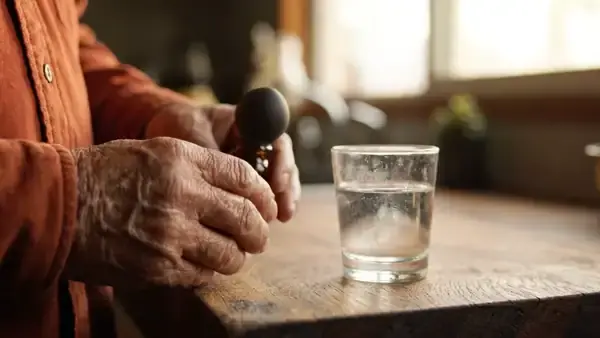
The cap is a black rubber bulb attached to a glass tube, and the whole of the dosing is one firm squeeze of that bulb.
The plants, in the order the label prints them, are gotu kola, ginkgo leaf, skullcap, sage and rosemary.
All five are certified organic, and two of them, the skullcap and the rosemary, go into the extract fresh rather than dried.
The liquid they sit in is certified organic cane alcohol at 56 to 66 percent, distilled water and certified organic vegetable glycerin.
The maker describes the taste as somewhat bitter with a hint of rosemary, which is exactly what five green plants in alcohol ought to taste like.
Now read the directions the way you would read the directions on anything you intend to use every day.
There are four of them, and each one is a small instruction about time.
- "Shake well before using." Plant extracts settle, so the first second of every glass is a shake.
- "Add 1 squeeze … to 2 oz. of water or juice." Every dose needs a glass, which means every dose needs a sink, a tap or a carton.
- "2 or 3 times per day." Not once. The bottle wants a place in your morning and your afternoon, and possibly your evening.
- "Best taken between meals." Not with breakfast, which is when most people take everything else.
Put those four together and the bottle is asking for something quite specific.
It is asking for two or three separate minutes of your day, away from the table, each with a glass in your hand.
That is a bigger request than it looks on a label.
A man who already takes something with breakfast has one habit and one moment; this bottle asks him to build two more.
The directions fit on a thumbnail. The routine they describe takes up a whole day.
Between Meals, on a Real Kitchen Clock
"Between meals" sounds like a vague phrase until you try to put it on a clock.
So let us put it on one.
Take an ordinary retired Tuesday.
Breakfast at seven, lunch a little after noon, supper around six, and the evening news somewhere after that.
Between breakfast and lunch there is a window from about nine to eleven.
Between lunch and supper there is a longer one, from about two to five.
Those are your two glasses. One at half past ten, give or take, and one at three.
If you want the third, it falls somewhere between eight and bedtime, after supper has settled.

Notice what that schedule has in common with the rest of a retired man's day.
Almost nothing.
The morning vitamins and the coffee cluster around breakfast, because that is when you are standing in the kitchen anyway.
The mid-morning and mid-afternoon are when you are out: the hardware store, the post office, the garden, the grandchildren, a drive.
The label asks for its glasses at exactly the hours when most men are furthest from the kitchen.
That single fact explains more of the reviews on this product than anything about the plants.
Why between meals at all?
The maker does not say, and the directions give no reason.
The usual herbalist's reasoning is that an extract meets less competition from food on an emptier stomach.
I found no study that tests that for this product or for these five plants, so read it as the maker's preference rather than a finding.
What it does mean in practice is that the one moment you are certain to remember, breakfast, is the one moment the label steers you away from.
If you take it with breakfast anyway, you are not breaking anything dangerous; you are simply not following the directions, and you should know that you have made that choice.
The hardest instruction on the bottle is not the dose. It is the time of day.
Two Glasses or Three: The Choice the Label Leaves to You
The directions say "2 or 3 times per day," and that small "or" deserves more attention than it usually gets.
It is the one decision on the label that the maker hands over to you.
Most men will read it as three, because three sounds like the full dose and two sounds like cutting corners.
That is not what the label says. It says two or three, and both are the directions as printed, which leaves room for how your own day is built.
There are good, ordinary reasons to choose two.
Two glasses fit the two windows of a normal day, mid-morning and mid-afternoon, without reaching into the evening at all.
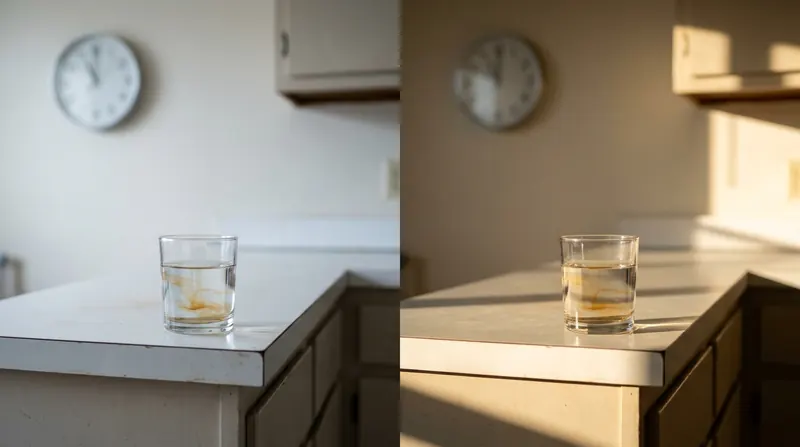
Two a day also stretches the one-ounce bottle from a fortnight to three weeks.
That gives you a longer, steadier look at the routine for the same bottle, and more room before the next order has to go in.
The third glass has its own logic.
It falls after supper, when the kitchen is quiet and you are likely to be home, which makes it the easiest of the three to remember and the latest in the day.
If you choose three, choose it on purpose and keep it every day.
Switching between two and three from one day to the next gives you neither routine, and it makes the bottle's length impossible to plan around.
So make the choice before the bottle arrives, write it on the calendar, and stay with it for the whole bottle.
Two steady glasses a day tell you more than three that come and go.
Two or three is your call, and the label says so. Pick one number and keep it for the whole bottle.
Why a Liquid Asks More of Your Day Than a Capsule Does
It is worth being clear about why this format behaves the way it does, because the format is the product.
A capsule is a closed container.
It hides the taste, it measures itself, and it goes down with whatever else is going down.
A liquid extract is open.
You measure it with your hand, you taste it, you need something to put it in, and you need the few seconds it takes to drink it.
Those few seconds are real, and they are not all bad.
A small glass taken at the same hour every day is a moment you notice, and a moment you notice is easier to keep than one you swallow without looking.
But they also mean the liquid cannot hitch a ride on the habit you already have.
Nobody carries two ounces of water in a jacket pocket, and nobody squeezes a bulb at a lunch counter without thinking about it first.
The taste matters here too.
The listing calls it somewhat bitter with a hint of rosemary, and two ounces of water is the label's way of softening that.
Juice is allowed, and it softens it further.
A small glass of orange or apple juice at half past ten is a pleasanter appointment than a small glass of bitter water, and a pleasant appointment is kept more often.
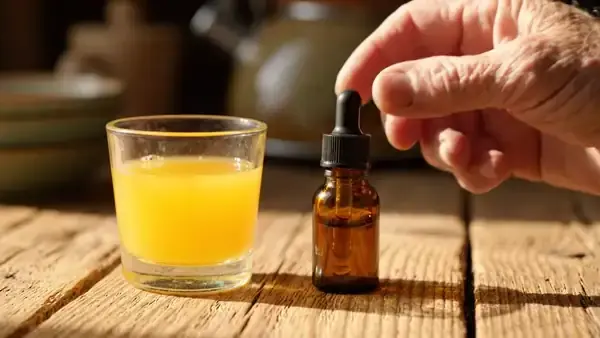
One reviewer on the maker's page takes a different route.
She writes that she puts it in her coffee every morning, and that when she gave up coffee for a while she gave up the squeeze with it.
That is a telling line about habits, and it is also worth a caution.
Coffee is not what the label names; it says water or juice, between meals, so her morning cup is her own arrangement and not the maker's instruction.
But look at what happened when the coffee went.
The squeeze went with it, because the squeeze was never its own habit; it was a passenger on another one.
That is the whole problem of this format in two sentences.
A liquid taken two or three times a day either becomes a habit of its own, or it rides on something else and falls off when that something else changes.
A capsule rides along with breakfast. This bottle has to be given a minute of its own, twice or three times a day, or it quietly stops being used.
The Trials Kept Schedules Too
Here is the part of the story that most write-ups of this bottle leave out.
Every study behind these five plants was also an appointment kept on a clock, by volunteers who were checked on to make sure they kept it.
That matters, because a study result belongs to its schedule.
A plant that was taken three times a day for two weeks in a trial has told you something about three times a day for two weeks, and nothing about the odd squeeze when you happen to remember.
So instead of reading the five plants one by one for what they do, this section reads them for when and how often they were taken in the research, and then for how much.
The plants appear in the order the label prints them.
Gotu kola: every day for two months
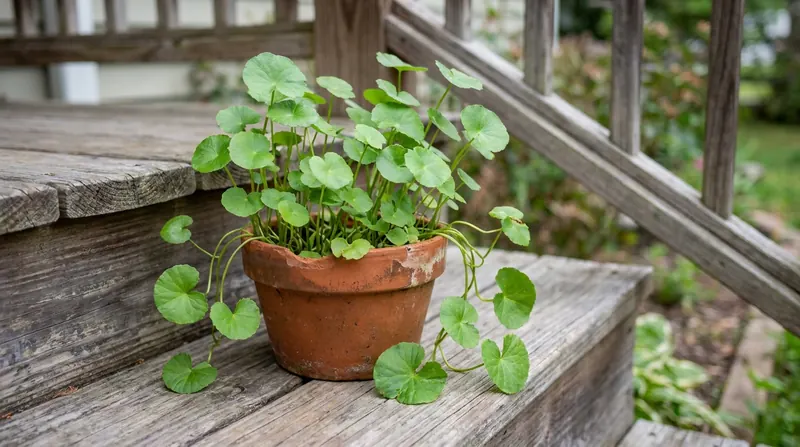
Gotu kola is a small creeping plant with fan-shaped leaves, eaten as a green in salads across South and Southeast Asia.
It comes first on this label, which in a blend listed by order usually means it is the largest share.
The study most often quoted for it ran for two months.
Twenty-eight healthy older adults took an extract every day, at one of three doses, and the group on the highest dose, 750 milligrams a day, did better on a working-memory task and rated themselves more alert. [1]
Two months, every day.
That is sixty straight appointments, and it was a small study, with only seven people in each group.
And a 2017 review that pooled the randomized studies of gotu kola found no significant effect on thinking-test scores overall, though it did find people rated themselves more alert. [2]
So the best reading is modest: a small, daily, two-month study with a good result, inside a larger body of research that comes out even.
Ginkgo: twice a day for six years, and once a day for twelve weeks

Ginkgo is the tree that lines the main streets of half the towns in America, the one whose fan-shaped leaves turn gold all at once in the autumn.
Its leaf has been sold for memory for decades.
Its largest study is also the longest appointment in this whole story.
In the Ginkgo Evaluation of Memory study, 3,069 adults aged 72 to 96 took 120 milligrams of a standardized extract twice a day, morning and evening, for a median of just over six years. [3]
Twice a day for six years, and at the end, the ginkgo group and the placebo group looked the same on memory, attention, language and every other measure the researchers took. [3]
That is as long and as faithful a schedule as anyone has ever kept with a supplement, and it did not separate from the dummy.
A smaller Australian study found something narrower.
In 93 healthy adults aged 55 to 79, 120 milligrams a day for twelve weeks was associated with better longer-term memory on one kind of learning task, with no difference on any other measure. [4]
The National Institutes of Health sums up the research by saying there is no conclusive evidence that ginkgo is helpful for any health condition. [5]
And note the unit in both studies: a standardized dry extract in milligrams, which is a different thing from the leaf in a liquid extract, as it is here.
Skullcap: three times a day for two weeks
Skullcap is a slender North American plant of the mint family with small blue-violet flowers set along one side of the stem.
It grows in wet meadows and along streambanks, and in this bottle its flowering tops go into the extract fresh.
In a double-blind, placebo-controlled crossover study of 43 healthy adults, 350 milligrams of American skullcap was taken three times a day for two weeks. [6]
It is the one schedule among the five plants that matches the label's own.
Compared with where people started, their total score on a standard questionnaire about how unsettled they felt went down, and their self-rated energy and thinking did not drop. [6]
One sub-score in that questionnaire did not differ from placebo, and the study measured how people felt, not memory or attention. [6]
Read that schedule again: three times a day, for two weeks.
It is the only study among the five plants whose timetable looks like this label's upper end, and one bottle at three squeezes a day lasts almost exactly two weeks.
That is a real coincidence of schedules, and it is worth being careful about what it means.
The volunteers took 350 milligrams of dried herb each time, and they were asked about how they felt, not about memory.
So the skullcap study tells you that a three-times-a-day routine over a fortnight is a normal thing to ask of people.
It does not tell you that this bottle, at its own amounts, does what that study measured.

Sage: one dose, then tested across the day
Sage needs no introduction to anybody who has made stuffing.
It is the gray-green, velvety kitchen herb of the Mediterranean, and it is fourth on this label.
Its studies used a different kind of clock altogether.
In twenty healthy adults over 65, with an average age of 73, a single 333 milligram dose of a standardized sage extract was followed by better scores on a delayed-recall kind of memory test and on accuracy of attention, measured at several points across the day, compared with placebo. [7]
In thirty healthy young adults, single doses of 300 and 600 milligrams of dried sage leaf were followed by better self-ratings, and the 600 milligram dose by better performance on a multitasking test. [8]
Both studies gave sage once and then watched the hours that followed.
That is the opposite of the ginkgo design, and it fits the label's idea of spreading doses through a day better than a long trial does.
But it also means nobody has tested sage taken daily for months, and nobody has tested it at a fraction of a squeeze inside a five-plant blend.
Rosemary: one dose, and more was worse
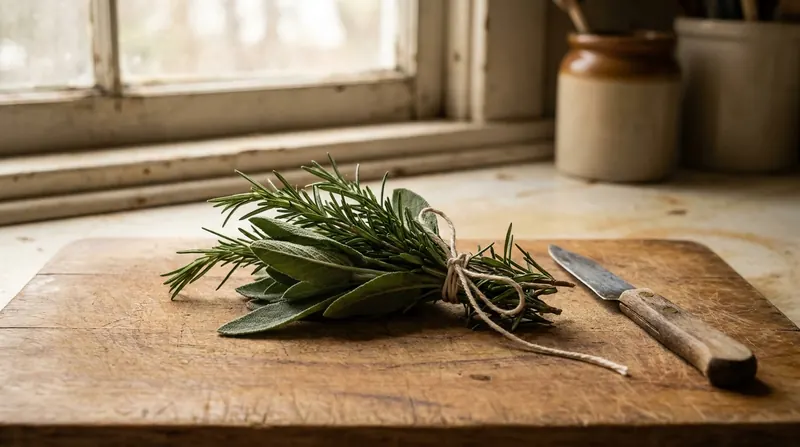
Rosemary is last on the label, and it is the one you can taste.
It has also been tied to memory for longer than any of the others: in ancient Greece and Rome it was an emblem of remembrance, and Shakespeare's Ophelia hands it out with the line "that's for remembrance."
Its study was a single-dose design in 28 adults with an average age of 75.
One dose of 750 milligrams of dried rosemary leaf, close to what you might use in cooking, was followed by faster speed of memory compared with placebo, while a much larger dose of 6,000 milligrams had the opposite effect. [9]
One dose, one morning, and a clear sign in the data that more is not better.
For a bottle you are asked to use up to three times a day, that is a useful thing to know.
Five plants, five different clocks: sixty days in a row, twice a day for six years, three times a day for two weeks, and single doses watched across one day. None of them is "whenever you remember."

A Squeeze Is Not a Study Dose, However Faithfully You Keep the Clock
Now the honest part about amounts, because a schedule only matters if the thing on the schedule is the thing that was studied.
The label gives one number for the whole blend.
A serving of 0.7 milliliters carries 646 milligrams of a certified-organic extract of all five plants together, and no amount is printed for any one of them.
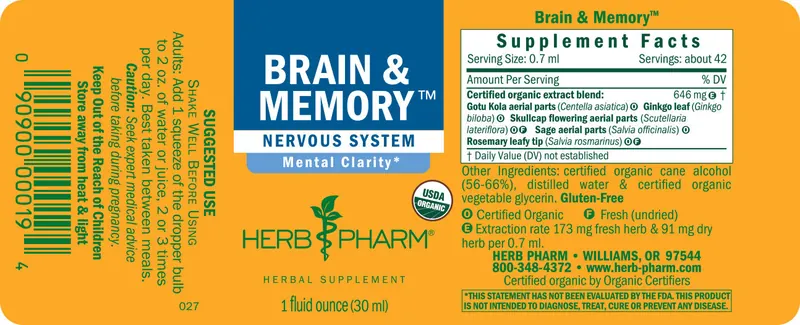
Beside that number the label prints an extraction rate: 173 milligrams of fresh herb, or 91 milligrams of dry herb, per 0.7 milliliters.
In plain words, one squeeze is made from roughly 91 milligrams of dried plant, shared five ways.
Set that beside the studies you have just read.
Gotu kola at 750 milligrams a day, ginkgo at 240 milligrams of standardized extract a day, skullcap at 350 milligrams three times a day, sage at 333 or 600 milligrams in one go, rosemary at 750. [1] [3] [6] [7] [8] [9]
Even at three squeezes a day, the bottle comes to around 270 milligrams of dried-herb equivalent across all five plants together.
No single plant in this bottle reaches the amount its own study used, and keeping the clock perfectly does not change that arithmetic.
That needs saying plainly, because the rest of this page is about keeping a routine.
A routine is worth keeping only if you understand what it is a routine of: a small, whole-plant, five-herb extract, used the way herbalists have used such extracts, rather than a study dose of anything.
Two more honest notes about the comparison.
Most of those studies used standardized dry extracts or dried leaf, which are different preparations from a fresh-and-dried liquid extract in alcohol, so the milligrams do not line up perfectly in either direction.
And several of them were small, single-dose or short.
Nobody has studied this blend, at this amount, on this schedule, and nobody is likely to.
Keeping the clock is how you give the bottle a fair hearing. It is not a way to make it bigger than it is.
Forty-Two Squeezes Make a Fortnight
Now the calendar, which is where a three-times-a-day product quietly succeeds or fails.
A calendar needs the thing it is counting, so this is the place to put the bottle itself on the counter.
Everything above was about plants and schedules; everything below is about how long this one small ounce lasts.
The label says up to 42 servings in a one-ounce bottle.
At three squeezes a day that is fourteen days; at two squeezes a day it is twenty-one.
The maker's own listing picture says "up to ~3 week supply per 1 oz bottle" and also says "Take up to 3x daily."
Both are true, but not at the same time: three weeks is the two-a-day figure, and at three a day the bottle is a fortnight.
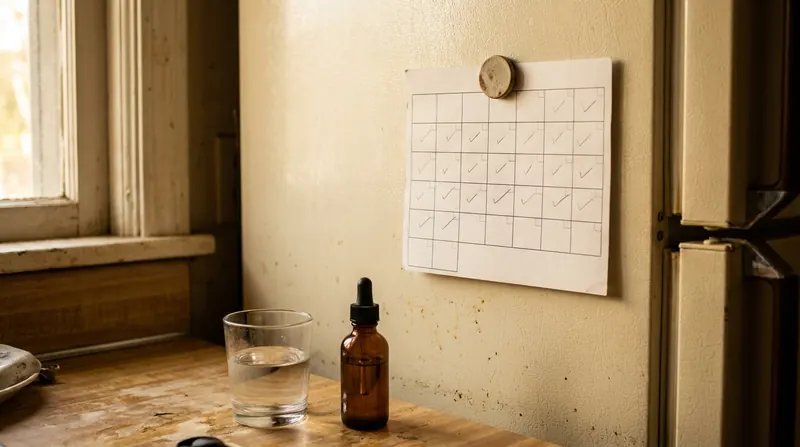
That difference matters more than it sounds.
A man who plans on three weeks and uses three a day finds the bottle empty on a Thursday with a week of his plan still to go.
Now add the post.
The maker's shipping page says orders are prepared within three business days and that standard delivery takes three to eight days in total, by UPS, inside the United States.
Put those two facts together and you get the one date that matters on this product.
At three squeezes a day, the next bottle should be ordered on about day seven of the first one, not on the day it empties.
At two squeezes a day you have more room, and ordering in the second week still leaves a margin.
Either way, the order date belongs in the same calendar as the glasses, because the gap between bottles is where most routines on this product break.
That is not a guess.
One reviewer on the maker's page, who had used the extract for a few months, wrote that her only difficulty was working out the time between ordering and delivery, and that she had been spending a week or more without it.
She was not complaining about the product.
She was describing a calendar problem, and a calendar problem is exactly what a fortnight bottle creates.

There is also a four-ounce bottle.
By simple proportion it holds about four times the servings, which is roughly eight weeks at three a day or twelve at two.
One of the reviewers on the page, a man of 71 who uses it with his wife, wrote that they were hoping the four-ounce size would be available soon.
For a couple both using it three times a day, a one-ounce bottle each is a fortnight, and the larger size is simply the practical one.
But the larger bottle also commits you to the longer experiment before you know whether you like it.
That trade-off leads straight to the store's return terms, which are shorter and narrower than the word "returns" suggests.
The maker's policy is thirty days from purchase, with a request for authorization first, and what it offers is an exchange or store credit rather than money back.
A one-ounce bottle at two or three squeezes a day is used up inside those thirty days, which means you will know what you think of it while that window is still open.
One ounce is a fortnight at three a day and three weeks at two. Order the next one around day seven, and decide inside the store's thirty days.
On and Off: What the Reviews Say About Keeping It Up
The five reviews quoted in this section come from the maker's own page, exactly as published and with their stars.
They are worth reading in a particular way.
The maker's review widget showed 23 reviews for this bottle when this article was written, averaging 4.8 stars: twenty at five stars, two at four and one at three.
Twenty-one of the twenty-three carry the widget's purchase mark.
That is a high share of a small number.
It is also, like every set of reviews for anything taken for memory, a set of personal impressions with no placebo group anywhere in it.
So do not read them for proof that the plants work.
Read them for what they say about the routine, because on that subject they are unusually candid.
One reviewer writes that he was skeptical, and that after using it "on and off for the past year" he is convinced it helps him.
The phrase that matters for this page is "on and off," and the line after it: "It's noticeable when I forget to take it for a few days."
He takes it "with my vitamins each morning," which is breakfast rather than between meals, and he forgets for days at a time.
That is an honest portrait of what a two-or-three-times-a-day product looks like in real life after a year.

I was skeptical, but after using this on and off for the past year, I am 1000% in! This stuff works - at least it does for me. I take it with my vitamins each morning. Everything seems more clear, and work comes easier. It's noticeable when I forget to take it for a few days.
Another reviewer, a woman who had been using it for a week, gave four stars rather than five because she expected effects to take several weeks.
She had ordered more, she wrote, "because one bottle won't do it."

I'm just now beginning to recognize some improvement in my memory (not enough to measure at this time), it's only been a week since I've been taking this supplement, as they do not produce immediate results, effects typically take several weeks with consistent daily use, but I'm hopeful and have experience great results with one other product; the 4 star is my belief that this supplement will soon show more positive effects, I've ordered more to continue, because one bottle won't do it
One bottle won't do it. That line is the fortnight calendar, written by a customer.
A third, a teacher, writes that she takes it before teaching a class.
That is a routine with a built-in cue: the class is on the timetable whether or not she remembers the bottle, and the bottle has been tied to it.

I like to take this before teaching a class to help me feel focused and sharp.
And the man of 71 wrote that he and his wife, at 71 and 72, figured "what have we got to lose?"
Between the two of them, that is two bottles a fortnight at the top of the label's range, which is a household routine rather than a personal one.

We are pleased with trying this out. Hoping that the four ounce is available soon. My wife and I are both using this. At 71 and 72, we figure 'what have we got to lose'?
The shortest review on the page is four words long: "I think it works."
It is the most honest sentence in the set, and it is also the whole difficulty with reviews of this kind of product.

I think it works.
I left out reviews that compare the bottle with other formats, that mention a health condition or something taken daily, or that talk only about shipping.
What is left is enough to see the pattern: the people who keep writing about it are the ones who found a place for it in their day.

Tying the Glass to Something You Already Do
If the reviews teach anything, it is that this bottle survives when it is tied to an event, not to a good intention.
Habits that last usually hang on a cue that happens anyway.
The teacher has her class, the man with the vitamins has his breakfast, and the woman with the coffee had her coffee until she didn't.
The label's timing, between meals, rules out the most obvious cue.
So the useful question is what already happens in your day at around half past ten and at around three.
- The second cup of coffee, or the end of it, is a cue at mid-morning for many men; the glass of water can come right after it.
- The mail arriving is a cue in a lot of small towns, and it tends to arrive at the same hour.
- A regular walk, a round of errands or the return from them is a cue, if the bottle lives by the door you come back through.
- The afternoon news, a crossword or a phone call you make every day is a cue for the second glass.
- Supper being cleared is the obvious cue for a third, if you use a third.
None of those are rules, and none of them are in the directions.
They are just the ordinary hooks a day already has, and the bottle does better on a hook than on a memory.
The other practical step is where the bottle lives.
A bottle in a bathroom cabinet is used when you are in the bathroom, which is rarely at half past ten.
The label says to keep it away from heat and light.
A kitchen shelf out of the sun, next to the drinking glasses and away from the stove, satisfies that and puts the bottle where the water already is.
Some people keep a second bottle so they never face a gap.
One reviewer on the maker's page wrote that she keeps a spare bottle for exactly that reason, after stopping for a while and noticing she wanted to get back to it.
That is a sensible arrangement for anyone who has already decided the bottle is worth keeping.
It is not a sensible way to start, because it doubles the commitment before the first fortnight has told you anything.
The glass goes on a hook the day already has, and the bottle lives next to the drinking glasses, out of the sun.
Two Ounces of Water, Three Times a Day, Adds Up
Here is a detail about this routine that nobody puts on a label, and it is one of the more useful things about it.
Every squeeze comes with two ounces of water or juice.
Three glasses a day is six ounces of fluid, and for a lot of men over sixty that is six ounces they would not otherwise have drunk between meals.
That matters more than it sounds.
In the Berlin Aging Study II, which followed 1,111 adults aged 60 to 89, those measured as underhydrated showed a steeper drop over time on a processing-speed test than those who were not. [10]
A 2021 review of eighteen studies in adults over sixty found some, though sparse, evidence linking too little water to poorer scores on tests of thinking. [11]
Those are associations, not proof, but they point in the same direction as common sense.
So be clear about what the glass is doing.
The water in it is not a carrier for the plants; it is water, and for some readers it may be the most useful ingredient in the whole routine.
You can have the water without the bottle, of course.
But if the bottle is what gets a glass into your hand at half past ten and at three, that is a small honest benefit of the format that has nothing to do with the plants.
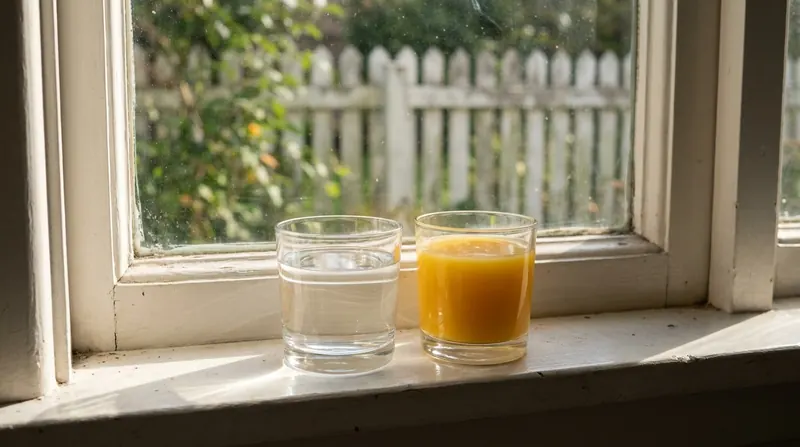
Some mornings the glass will matter more than what goes into it.
The Cane Alcohol, Said Plainly
A liquid extract has to be extracted into something, and this one is extracted mostly into alcohol.
The label lists certified organic cane alcohol at 56 to 66 percent, with distilled water and vegetable glycerin.
A 0.7 milliliter serving at around sixty percent is roughly 0.4 milliliters of alcohol, which is a good deal less than a sip of wine.
At three squeezes a day it is a little over a milliliter, spread across six ounces of water.
By any ordinary measure that is a very small amount.
But small is not none, and a three-times-a-day routine makes it a daily amount.
If you avoid alcohol completely, for your own reasons or for someone else's, you should know this before the bottle arrives.
If you are in recovery, this is a conversation for the person who knows your history, not for a page like this one.
And if you take anything daily, the pharmacist who fills it is the right person to ask about a small daily amount of alcohol alongside it.
The alcohol also explains two things about the routine.
It is why the extract keeps on a shelf without refrigeration, and it is why the label specifies two ounces of water rather than a sip, because neat it would taste of alcohol before it tasted of plants.
The glycerin works the other way.
It is sweet, it rounds off the bitterness, and it helps carry some plant compounds that alcohol alone leaves behind.
About 0.4 milliliters of cane alcohol per squeeze, diluted in two ounces of water: tiny, daily, and worth saying out loud.
Where the Plants Start Their Day
A blend with no amount printed for each plant rests heavily on who made it, so the maker is part of the product.
Herb Pharm has made plant extracts in southern Oregon since the 1970s.
The label still prints Williams, Oregon, the small southern Oregon town where the company's farm is; the contact page gives Central Point, Oregon, where the mail and the returns go.

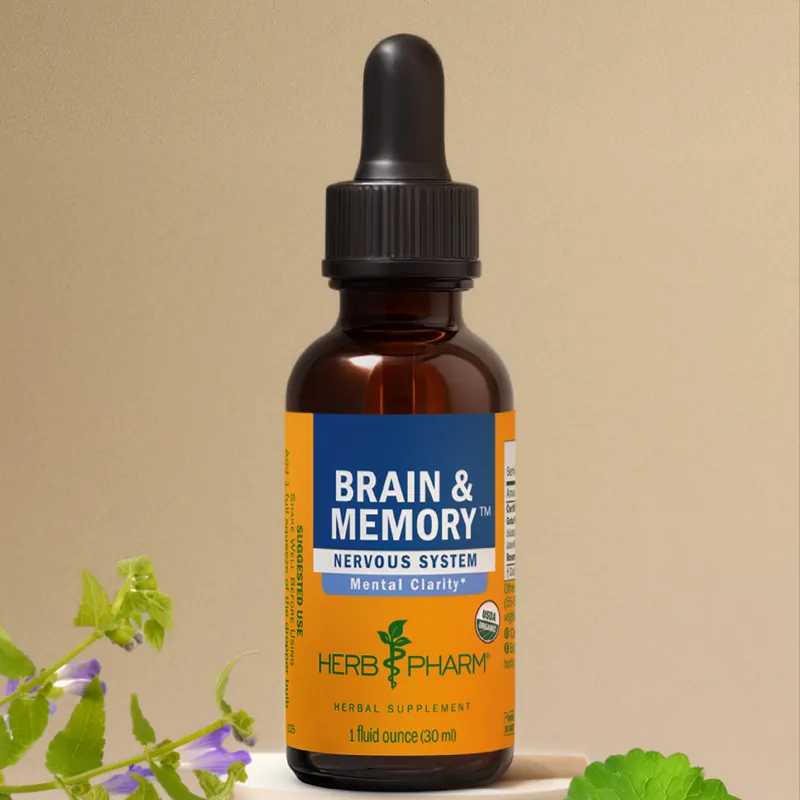
Two of the five plants in this bottle, the skullcap and the rosemary, go into the extract fresh rather than dried.
That is a choice a company only makes when the plant is close at hand, because a fresh plant has to be extracted soon after it is cut.
The listing carries several marks, and each one certifies something narrow.
Certified organic, by Organic Certifiers, describes how the plants were grown and handled; non-GMO describes the seed; vegan and made without gluten describe what is absent; made in the United States describes where.
The mark worth a sentence of its own is "Identity Verified."
On a five-plant blend with no individual amounts, a check that each plant is the plant on the label is worth more than any of the marketing around it.
It still tells you nothing about how much of each plant is there, and nothing about whether any of them does what a buyer hopes.
Provenance and identity are real virtues, and they are a different question from dose.
A farm in a small Oregon town, two plants put in fresh, and an identity check on all five. Good answers about where the bottle comes from, none about how much is in it.

What Stopping Tells You, and What It Doesn't
Two of the reviews on the maker's page say the same thing in different words: they noticed a difference when they stopped.
One man says it is noticeable when he forgets for a few days; one woman says she stopped for a while and realized it had been helping more than she knew.
That is the most persuasive kind of review a person can write, and it deserves a careful reading rather than a dismissive one.
They are describing their own days honestly, and nobody can tell them they did not feel what they felt.
But notice what "noticing when I stop" cannot separate.
When a man stops a three-times-a-day routine, he also stops the six ounces of water between meals, the two small pauses in the morning and afternoon, and the small daily act of doing something on purpose for his own head.
Any of those could be what he misses, and the plants are only one of them.
And a man who expects to feel worse when he stops something will often feel worse, which is why careful studies hide from everyone who is on the real thing and who is on the dummy.
None of that means the reviewers are wrong.
It means the only fair way to judge this bottle in your own life is to keep the routine steady for long enough to know what the routine itself feels like.
A routine kept on and off can only ever tell you that you like the routine.
What No Timetable Adds to the Bottle
It would be easy for a page about keeping a schedule to make the schedule sound like the whole answer.
It is not, and here is the plain list of what keeping the clock perfectly will not do.
- It will not bring any of the five plants up to the amount its own study used; a squeeze is about 91 milligrams of dried plant shared five ways.
- It will not turn a single-dose study of sage or rosemary into evidence for months of daily use.
- It will not change the result of the six-year ginkgo study, which was kept twice a day by thousands of people and did not separate from placebo.
- It will not replace a proper look at a worry about your memory that has been with you for months; that belongs with your own clinician.
- It will not take the alcohol out of the extract, or remove the need to ask your pharmacist if you take anything daily.
- It will not stand in for water, meals, walking, hearing and company, which are the parts of the day with the better research behind them.
That last line needs its own section.

Before the Bottle: The Day's Other Levers
If you are going to reorganize your day around two or three small glasses, it is only fair to look at what else the same day could hold.
Several of those things have better support than any plant in this bottle, and most of them cost nothing.
Water is the first, and you have already read why.
If the bottle is what gets six more ounces into you between meals, good; if it is not, a glass at half past ten and at three is worth having on its own. [10] [11]
The plate is the second.
In a Brazilian study that followed 10,775 adults for about eight years, those who ate more than the lowest quarter of ultraprocessed food showed a faster drop in thinking-test scores over time than those who ate the least. [12]
And in a three-year randomized trial of 604 older adults, a Mediterranean-style eating pattern and a comparison diet with mild calorie cutting both improved thinking scores, with no significant difference between them. [13]
The honest reading is that eating better in either direction helped, and that no single pattern owns the result.
The walk is the third, and the one most men already know about.
A walk at three o'clock is also a very good cue for a glass of water when you get back.
Your ears are the fourth.
A man who is missing words in conversation sometimes has an ear problem rather than a memory one, and a hearing check is quick, ordinary and worth doing before you conclude anything about your recall.
Company is the fifth.
The call you make every afternoon, the coffee on Main Street on a Thursday, the lodge, the church supper: conversation is exercise for exactly the parts of the head a memory formula is bought for.
None of that is an argument against the bottle.
It is an argument for putting the bottle in its right place: a small addition to a day that already has water, food, walking, hearing and people in it.
Water, the plate, a walk, a hearing check and company come first. A small glass at half past ten fits alongside them, not instead of them.
A Fourteen-Day Timetable, If You Buy It
If you have read this far and still want to try the bottle, here is the fairest way to do it, built around the one thing this page is about.
- Buy the one-ounce bottle, not the four-ounce, and not two of anything.
- Pick your two times before it arrives: one between breakfast and lunch, one between lunch and supper, each tied to something that already happens.
- Decide whether you are a two-a-day or three-a-day user and stay with it; two a day gives you three weeks, three a day gives you two.
- Keep the bottle on a kitchen shelf next to the glasses, out of the sun.
- Shake it, one squeeze, two ounces of water or juice, and drink it.
- Put a small pencil mark on a calendar each time, and nothing else.
- If you are using three a day and want to continue, order the next bottle around day seven.
- At the end of the bottle, look at the calendar before you look at how you feel.
That last step is the important one.
If the calendar has gaps all over it, the experiment has not happened yet, whatever you feel.
If the calendar is full and you notice nothing, that is a clean answer, and you have spent one bottle finding it.
If the calendar is full and you feel sharper at half past ten, you have a routine you like, and you can decide whether the plants, the water or the pause deserve the credit.
Either way you will know inside the maker's thirty-day window, and you will have learned it from your own days rather than from a label or a review.

Fourteen days, a pencil and a glass. That is the whole experiment.
Who Suits Three Glasses a Day, and Who Doesn't
Put plainly, this bottle suits a particular kind of day and a particular kind of man.
- You are home for much of the day, or your day has fixed points at mid-morning and mid-afternoon.
- You like the idea of a certified-organic, whole-plant extract from a small Oregon maker more than a capsule of standardized extracts.
- You do not mind a bitter taste, softened by water or juice.
- You are comfortable with a very small daily amount of alcohol.
- You are prepared to keep a simple two-week routine before deciding anything.
And it does not suit these readers.
- You avoid alcohol entirely, or you are in recovery.
- You want a single number on the label for each plant, and a dose that matches a study.
- Your days are on the road, and a glass of water at half past ten is not realistic.
- You take anything daily and have not yet asked your pharmacist about these five plants and the alcohol.
- You are pregnant or nursing; the label itself says to seek expert medical advice first.
- You have been worried about your memory for months; that conversation belongs with your own clinician first.
One more caution, from the plant files rather than the label.
Rare reports of harm to the organ that processes what you swallow have been linked to products containing gotu kola or skullcap, so stop and call your clinician if you notice unusual tiredness, dark urine, or yellowing of the skin or eyes.
Ginkgo may add to the effect of anything you take that thins the blood, so mention it before an operation and to the pharmacist who fills anything you take daily.
Those are small risks, honestly stated, and they are the reason the fourteen-day plan begins with one bottle.
Where It Comes From, and How It Gets to Your Door
The bottle is sold on the maker's own site by Herb Pharm, LLC, 5448 Bierson Way, Central Point, Oregon 97502.
Their phone number for orders is 800-348-4372, the email is info@herb-pharm.com, and the phones are staffed on weekdays from seven in the morning to half past four, Pacific time.
Orders go out within three business days and arrive in three to eight days in total by UPS, to the continental United States, Hawaii and Alaska.
Shipping costs nothing on orders above forty-nine dollars by ground inside the continental states, and a single one-ounce bottle will not reach that line on its own.
The return terms are thirty days from purchase.
You ask for an authorization number first, and what the store offers is an exchange or a store credit rather than money back.
That is narrower than "easy returns" on the listing suggests, and it is worth knowing before you order.
The one-ounce bottle is used up inside those thirty days at either of the label's schedules, which is the best argument for starting with it.
The listing also shows a picture of a four-ounce "value size" marked for another retailer.
The buttons on this page go only to the maker's own listing.
Seven quick answers about the daily routine
Can I take it with breakfast?
You can, but the label says between meals. Breakfast is the easiest time to remember and the one the directions steer away from.
Water or juice?
Either, two ounces. Juice softens the bitter taste, and a pleasant glass is easier to keep.
How long does one bottle last?
A fortnight at three squeezes a day, three weeks at two. The four-ounce bottle holds about four times as much.
When should I reorder?
Around day seven if you use three a day. Delivery takes three to eight days in total.
Is there alcohol in it?
Yes, about 0.4 milliliters per squeeze from cane alcohol, diluted in two ounces of water.
What if I miss a glass?
Take the next one at its usual time. Nothing on the label says to double up.
What if it is not for me?
The store offers an exchange or credit within thirty days, with an authorization number first.
The Whole Day, Folded Small
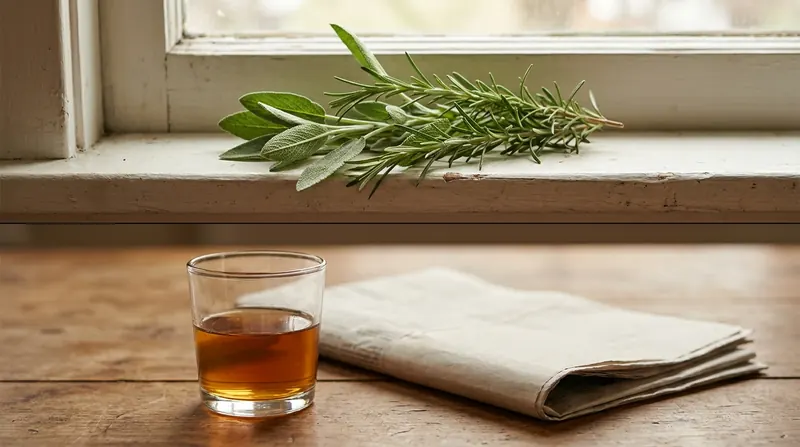
- A one-ounce amber bottle of five certified-organic plants in cane alcohol, water and glycerin, made by Herb Pharm in southern Oregon.
- The directions ask for one squeeze of the bulb in two ounces of water or juice, two or three times a day, between meals.
- Between meals means about half past ten and about three, the hours most men are away from the kitchen.
- Every study behind the five plants ran on a schedule: two months daily for gotu kola, twice a day for six years for ginkgo, three times a day for two weeks for skullcap, single doses for sage and rosemary. [1] [3] [6] [7] [9]
- The overall picture is modest: a pooled gotu kola review and the six-year ginkgo study came out even. [2] [3]
- One squeeze is made from about 91 milligrams of dried plant shared five ways, well under every study dose.
- Forty-two squeezes is fourteen days at three a day; order the next bottle around day seven.
- The reviews are candid about keeping it up: "on and off," "noticeable when I forget," "one bottle won't do it."
- Three glasses a day add six ounces of water between meals, and water has its own research behind it. [10] [11]
- About 0.4 milliliters of alcohol per squeeze, and a word with your pharmacist if you take anything daily.
- Returns are thirty days, for an exchange or credit, which a one-ounce bottle fits inside.
The Last Glass of the Day
There is a quiet irony in a bottle called Brain & Memory that asks to be remembered three times a day.
The maker probably did not intend it, but it is the most useful way to think about the product.
If you cannot find a place for two small glasses in your day, the plants never get a hearing, and no review or study will change that.
If you can, you get a fair two-week look at a small, honest, whole-plant extract, plus six ounces of water and two quiet minutes you might not otherwise have had.
That is not a large promise, and it is not meant to be one.
It is a small bottle with a small, daily appointment attached, from a maker with a farm in a small Oregon town.
The reviewer who wrote "I think it works" did not say more than he knew.
Neither should anybody else, including this page.
Pick your two times. Then see whether the bottle keeps its appointment with you.
The full ingredient guide for this bottle, with what each of the five plants is, how it has been used and what to watch for, is linked at the foot of this page.
It lists the carrier as well: certified organic cane alcohol, distilled water and certified organic vegetable glycerin.
Two glasses a day, from a farm town in southern Oregon
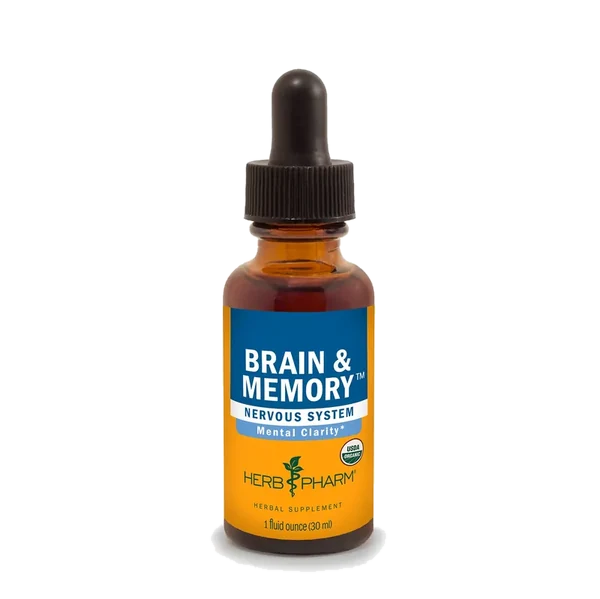
A certified-organic liquid extract of five herbs (gotu kola, ginkgo, skullcap, sage and rosemary) in cane alcohol, water and glycerin, taken as one squeeze of the bulb in two ounces of water, two or three times a day.
SEE THE BOTTLE AND ITS FOUR LINESSold by Herb Pharm, LLC, Central Point, Oregon · 800-348-4372 · one squeeze in two ounces of water or juice, two or three times a day, between meals · exchange or credit within 30 days
The link above goes to the maker's own listing, where the current price, both sizes and the full label are shown.
Nothing on this page asks you to buy more than one bottle, and nothing should.
The one-ounce bottle lasts a fortnight at three squeezes a day, inside the store's thirty days.
P.S. If you remember one number from this page, make it seven.
At three squeezes a day, day seven is when the next bottle should be ordered, because day fourteen is when the first one is empty and the post takes up to eight days.
P.P.S. If a worry about your memory has been with you for months, and it is there on the good days as well as the tired ones, see your own clinician before you buy anything at all.
A small bottle on a kitchen shelf was never meant to answer that question, and an ordinary appointment answers it better.